Vulnerabilities to American Defense Industrial Base: A Briefing
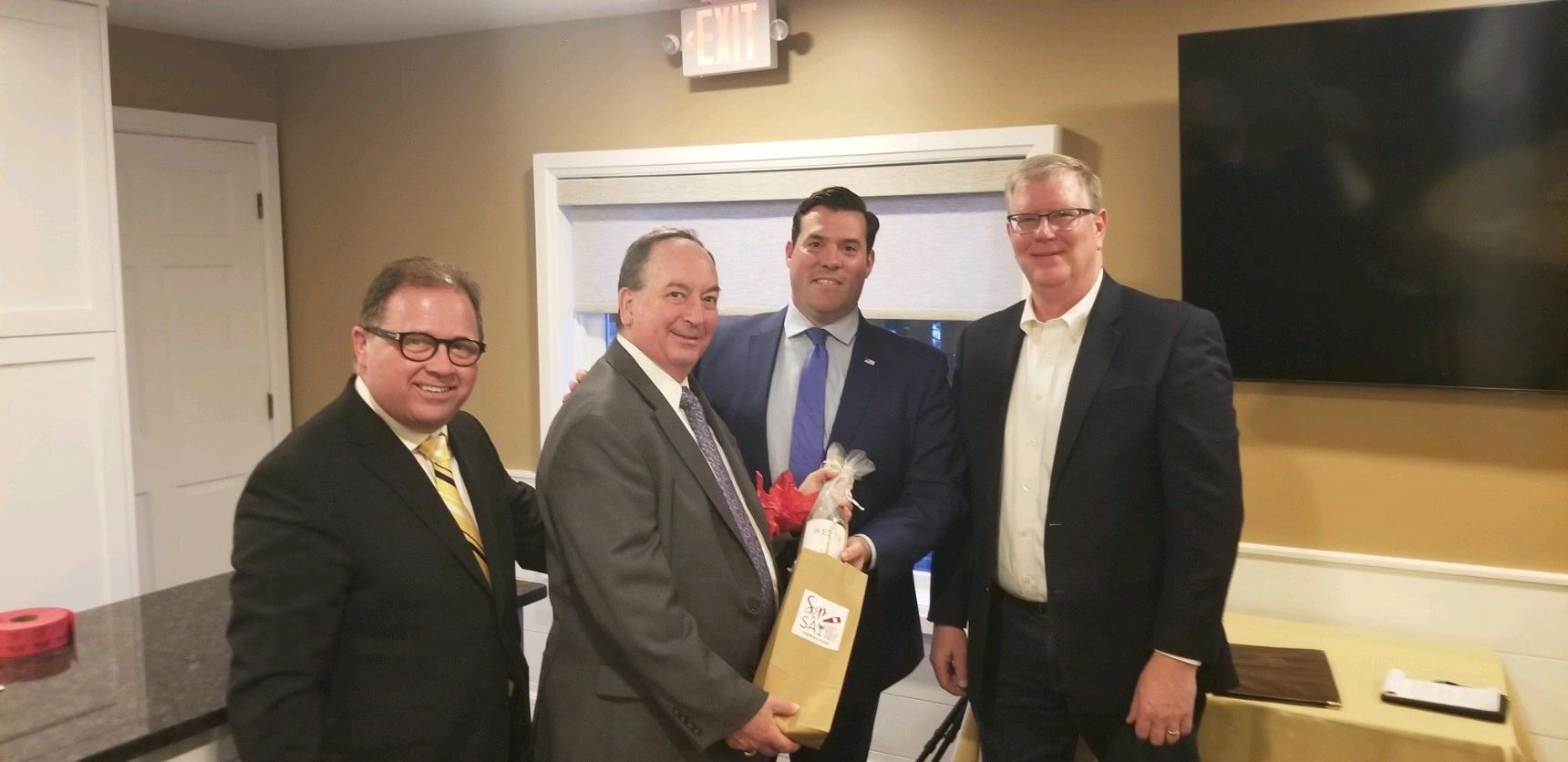
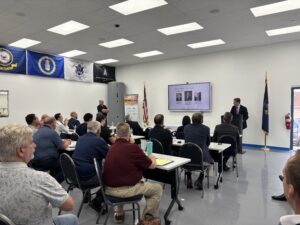
(4/11/23, Hauppauge, NY) Last week, IgniteLI Executive Director Patrick Boyle delivered the keynote address to members of ASIS, a global community of security practitioners who represent the network of professionals keeping our critical assets and key resources safe from threats. Patrick broke down the conventional and unconventional threats to American manufacturing, focusing on defense production and those critical manufacturing sectors key to maintaining homeostasis here on Long Island and across the country. Here are a few of Patrick’s takeaways identifying some of the strongest points in our current business climate.
Manufacturing on Long Island has evolved into a network of 11 different industrial sectors which Patrick identified as a strong point for our economic health as a region. Patrick said, “Offering diverse production for many different industries means that global economic changes which might impact one sector, may not impact all sectors, meaning we are more immune to those global changes.” The example he gave was a “chain of restaurants remains healthy even if one of its franchises closes. Similar to those restaurants, even if one industry sector experiences a downturn, the community of businesses endures.” Patrick went on to say, “Many industry sectors mean a more well-rounded skilled labor workforce. Workers might experience growth in an aerospace company, then move their career in another direction to a pharma company, bringing with them the institutional knowledge gleaned from a different company. These are great strengths few regions of the world experience. Long Island’s ethnic and industrial diversity means we are more immune to global market changes, have more well-rounded skilled labor, and possessing many worldviews, and bring better solutions to complex problems. Patrick went on to discuss some of the challenges to security we face here on Long Island.
The conventional concerns for key manufacturing sectors, especially those here on Long Island and in other high-density regions of the world are complex. Hard target vulnerabilities are always of chief concern, “I think that as New Yorkers, we are already in a “hyper-vigilant” state, our employees are great about pointing out suspicious activity on and off the shop floor, and we benefit from a great network of law enforcement agencies across Nassau and Suffolk counties.” said Patrick. He went on to discuss the new world of cyber intrusion, especially as we modernize our shop floors with aspects of Industry 4.0, Robotic Process Automation (RPA), and more virtual workforce options for off-the-floor jobs.
Patrick quoted a Cybersecurity and Infrastructure Security Administration (CISA) study that said, “Historically, cybersecurity services for industrial processes were an operational function performed by plant engineers and operators. However, as cyber-attacks become more sophisticated, the skills needed to detect and respond to threats have greatly expanded. Consequently, organizations must augment their Industrial Control Systems or ICS cybersecurity operations accordingly. Unfortunately, these increased requisite skills (such as remote ICS management) expand the knowledge gap between traditional IT security analysts and those required to support manufacturing environments. For example:
A Manufacturing Engineer position requires two or more years of managing ICS and vendor/industry-specific certifications, on top of standard IT security experience. This heightened demand for talent also affects the talent pool available to effectively respond to these threats.
If current trends hold, attacks against manufacturing sector infrastructure will continue to increase. Environments previously ‘air-gapped’ may become more connected to enterprise networks, as well as to public clouds, vendor networks, and other third parties for remote management. This rapid expansion of the threat landscape and attack surface has made it far more likely manufacturing organizations will experience a cyber event significant enough to degrade or impede the safety and availability of production. Supply chain attacks or disruptions further complicate manufacturing’s need to operate safely. A new threat to manufacturing—ransomware (a prevalent form of cyber-attack during the pandemic due to high IT infrastructure reliance)—has begun to target systems lacking the inherent security controls required to protect themselves. The result can be catastrophic production loss and downtime as well as lost revenues and penalties for production delays.” (CISA)
Intelligence theft and Intellectual Property theft were also high on Patrick’s list of conventional cyber threats. Industrial “Choke Points” are the “greatest threat of all, cutting off the supply of key resources needed for the production of defense or medical material is the scariest scenario,” said Patrick. “Similar to the Allied strategic bombing campaign of World War II which identified manufacturers of ball bearings as a strategic industrial “choke point” there exist today choke points which can be impacted naturally, such as during the global supply chain shortage, via hard target sabotage or cyber intrusion,” said Patrick. Cyber and hard target threats are conventional and should not surprise the reader. Patrick focused the second half of his discussion on topics foreign to the audience but certainly discussed daily within the IgniteLI network of manufacturers.
Patrick’s Concerns for America’s Defense Industrial base are twofold; the skilled labor shortage, and the supply chain of essential products to manufacturing. Across the modern world, the well-known trend of retirement-aged workers leaving the shop floor with no skilled labor to take their place is well known in our manufacturing circles. Thankfully the Department of Defense is beginning to take notice;
-U.S. Defense Industrial Base has declined by 40 percent in the last decade. That’s both an economic and national security risk for our nation as we seek to strengthen our domestic supply chains, increase competition, and reduce dependency on single and foreign sources of supply. (DoD)
– Last year alone the Department of Defense spent $83 billion on small business prime contracts and nearly 25 percent of DoD’s prime contracts go to small businesses. (DoD)
“The Defense Industrial Base Talent Pipeline is a serious concern and thankfully we are seeing some serious commitment come out of our Federal Government Partners. Here at home, there is nearly 8,000 unfilled “help wanted” postings across Nassau and Suffolk Counties,” said Patrick. He went on to discuss the need to “reshore” critical operations and locate domestic suppliers.
The Supply of critical products to American Manufacturers is his second concern for homeland defense. “The Supply Chain Crisis brought on by the COVID19 Pandemic showed us the failure of a global dependence on foreign goods,” said Patrick. He went on to express the significance this has for critical healthcare industries, highlighting that there are “too few manufacturers of critical daily medications which rely on imported goods to produce daily doses for our most at-risk populations,” he said. But it is not all bad news, Patrick rounded out his discussion by highlighting 3 of the strength points he mentioned earlier in his speech;
Diversity- Diversity is our region’s greatest strength, many Industry sectors mean market resiliency (opposed to singular industry). Well-rounded employees bring different worldviews to solve today’s most complex problems.
Reshoring- We are reducing our dependence on single-source and foreign-source supplies, opting for domestic suppliers of raw goods and parts, understanding that reliability is more valuable today than overhead cost.
DoD Commitment- The Department of Defense released its new National Defense Strategy, which provides a clear and rigorous strategy for advancing the United States defense and security goals. A key pillar of the NDS is the Department’s desire to build enduring advantages by strengthening our defense industrial base and bolstering support for small businesses and other innovative technology firms that support the systems on which the military depends and will help ensure the United States maintains its military advantages.
Patrick Boyle is the Executive Director of IgniteLI, the manufacturing trade association of Long Island. He is the former Director of the New York State Senate standing committee on “Veterans, Homeland Security, and Military Affairs.” Patrick is also a graduate student at Long Island University’s “Homeland Security Management Institute” and a graduate of The Citadel, the Military College of South Carolina where he studied International Relations & Military Affairs.